
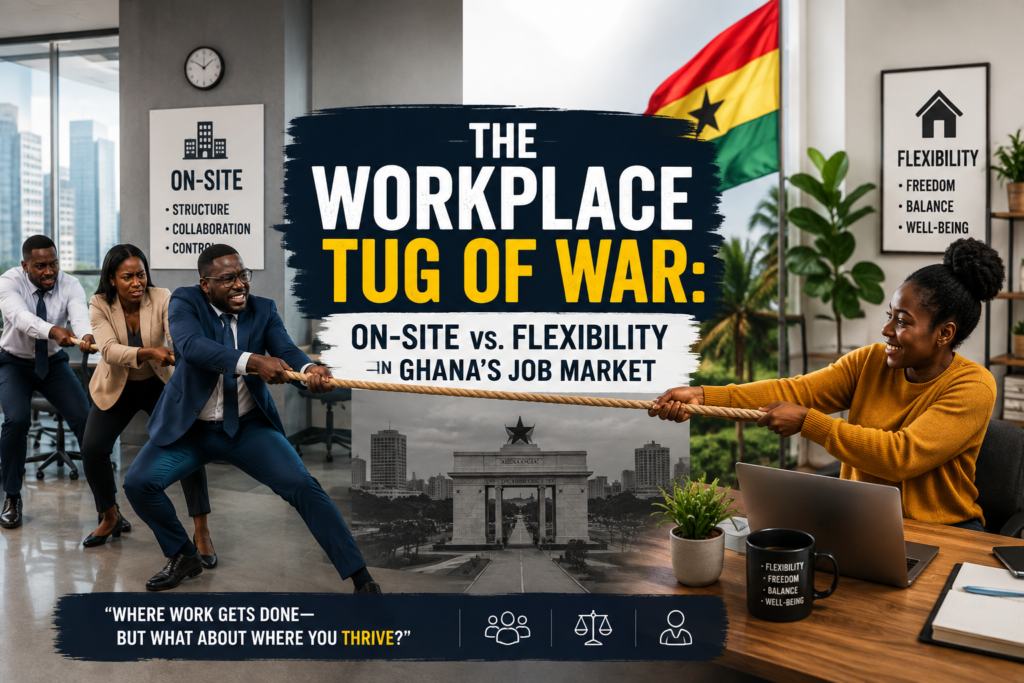
On-Site vs. Flexibility in Ghana’s Job Market
I have spent the last few months scrolling job boards for a living, and one pattern keeps repeating itself. A company posts a role for a digital marketer, a social media manager, or a virtual assistant, three jobs that exist almost entirely on a screen, and still writes “must work on-site, Monday to Friday” in the description. Meanwhile, the candidates most qualified to fill that role, mostly Gen Z, are scrolling past it and applying to the remote listing right below it instead.
This is not a small mismatch. It is a quiet standoff playing out across Ghana’s job market, and it is starting to cost employers the very talent they are trying to hire.
Two Sides, One Job Market
On one side sits HR and management, insisting on physical presence. On the other sits a generation of young professionals asking why they should commute two hours in Accra traffic to do work that lives entirely in a laptop. Both sides have reasons. Neither side is entirely wrong, and that is exactly why the conversation deserves more attention than it is getting.
Why employers want people in the building
Ask most HR managers why they prefer on-site work, and the answer usually comes down to control and culture. Cisco’s 2025 Global Hybrid Work Study found that older managers are consistently more skeptical of remote productivity than younger ones: only 28% of Boomer-generation employers believe remote work is as productive as office work, compared with 48% of Gen Z employers surveyed in the same study. That gap in belief shapes policy long before it shows up in a job posting.
There are legitimate concerns underneath that skepticism. Supervision is harder from a distance. Mentorship happens faster in person. New hires learn company culture by watching how people behave in a room, not just what they say on a Zoom call. And in Ghana specifically, many organisations still measure output by hours logged rather than results delivered, a habit that on-site work makes easier to enforce, even if it is not always fair.
Why Gen Z wants out of the building
Now flip to the other side of the desk. Deloitte’s 2025 Gen Z and Millennial Survey, which polled more than 23,000 people across 44 countries, found flexible work arrangements sitting near the top of what young workers say they need to stay in a job. Globally, 65% of Gen Z and Millennial respondents said they would leave a job if forced back to the office full-time.
Locally, the picture is just as sharp. HR consultant Gifty Akorfa Kumah, who places Ghanaian talent into international roles, has described today’s young job seekers as wanting more than a salary. They want freedom, purpose, and room to grow beyond Ghana’s borders. That framing matters, because for many Ghanaian Gen Z workers, remote flexibility is not a lifestyle preference. It is a financial escape hatch.
Ghana’s minimum wage sits at roughly GHS 21.77 a day as of January 2026, and local salary benchmarking rarely accounts for the real cost of living or the global rate for digital skills. A Ghanaian remote worker doing marketing, design, or virtual assistant work for an international client can realistically earn between $30 and $91 an hour, several times what the same skill set commands locally. When an employer in Accra asks a social media manager to sit in an office all week for a fraction of what a remote client would pay for the same output, it is not hard to understand why that employee starts checking LinkedIn during lunch.
The Cost of Getting This Wrong
The tension is not theoretical. It shows up in turnover numbers. Gen Z workers average just 1.1 years in a role, compared to 2.8 years for Gen X, a gap researchers link directly to how well an employer’s flexibility matches what the employee actually wants. In the UK, 93% of surveyed workers said they would consider quitting if remote flexibility were taken away. There is no reason to believe Ghanaian professionals feel differently once they have tasted what flexible, output-based work looks like.
Employers who ignore this are not just losing individual staff members. They are training their best digital talent to see freelancing and remote international contracts as the real career path, and the local job market as a stepping stone at best. That is a slow leak of exactly the skills Ghana’s growing digital economy needs to keep at home.
And yet, rigid remote-only policies are not automatically the answer either. Interestingly, newer Gallup research complicates the “Gen Z wants to work from home forever” narrative. Only 23% of remote-capable Gen Z workers actually prefer fully remote work, the lowest share of any generation, largely because loneliness and lack of mentorship set in fast when you never see a colleague in person. What most Gen Z employees are actually asking for is hybrid: some structure, some flexibility, and a say in which days they show up.
Where the Harmony Might Actually Be
None of this has to end in a standoff. A few shifts, on both sides, could close the gap.
Employers can define roles by output, not location. If a digital marketing role can be measured by campaign performance, engagement numbers, or leads generated, then where the person sits while producing those numbers matters far less than the numbers themselves. Roles like social media management, content creation, and virtual assistance are already built for this kind of measurement. Forcing them into a physical seat because “that’s how we’ve always done it” is a policy choice, not a business requirement.
HR can build hybrid structures with intention, not by accident. A 2023 Ghana Employers Association study found that 65% of businesses that adopted remote arrangements reported productivity gains, alongside a 40% rise in reported job satisfaction. The businesses that saw those gains were not the ones that simply let people disappear from the office. They were the ones that set clear in-office days for collaboration and mentorship, and left the rest of the week to individual judgment. That distinction between “flexible” and “unmanaged” is where most hybrid policies succeed or fail.
Pay needs to reflect the market a company is actually competing in. If a Ghanaian employer wants a digital marketer to choose the office over a remote international contract, the salary on offer has to be honest about what that skill is worth, not just what the company down the road is paying. Compensation built entirely on local benchmarking will keep losing out to a global market that pays in dollars.
HR needs to understand who it is actually hiring. Gen Z did not grow up watching their parents get rewarded for loyalty to one employer. Many watched their parents get laid off despite it. They grew up online, building side income before they had a first job, and measuring opportunity globally rather than locally. An HR department that still leads with “this is how things are done here” will keep losing candidates to companies that lead with “here’s what you’ll actually get out of this.” Understanding that shift is not about indulging a generation. It is about recruiting one.
What Flexibility Actually Buys an Employer
The businesses resisting flexibility often assume they are protecting productivity. The data mostly says the opposite. Beyond the Ghana Employers Association findings above, a Stanford randomised trial involving 16,000 workers recorded a 13% performance increase among employees given remote or hybrid options, driven by longer effective working time and faster task completion, not less effort. Global data also shows that employees with genuine choice over where they work are far more likely to stay with their employer, cutting the cost and disruption of constant rehiring.
For a Ghanaian company, that translates into lower turnover, lower recruitment costs, and access to a talent pool no longer limited to people willing to commute into Accra or Kumasi every day. It also means less reason for a company’s best digital hires to treat the job as a placeholder while they build a remote career on the side.
A Closing Thought
I do not think most HR departments in Ghana are being deliberately unfair. I think many are running on inherited assumptions about what “real work” looks like, assumptions that made sense before a laptop and a stable internet connection could do the job of an entire office. The employers who update that assumption first will be the ones who keep their best people. The ones who do not will keep training talent for someone else’s remote team.
Flexibility is not a trend to wait out. It is already the difference between who gets to hire Ghana’s best digital talent, and who gets left refreshing job boards wondering where all the good candidates went.
About the Author

I am Kelvin Kwesi Danquah, a digital marketing consultant and B2B Growth strategist based in Accra, Ghana. I build the strategy that turns your digital presence into your most powerful business development and client acquisition tool.
Follow me on LinkedIn