
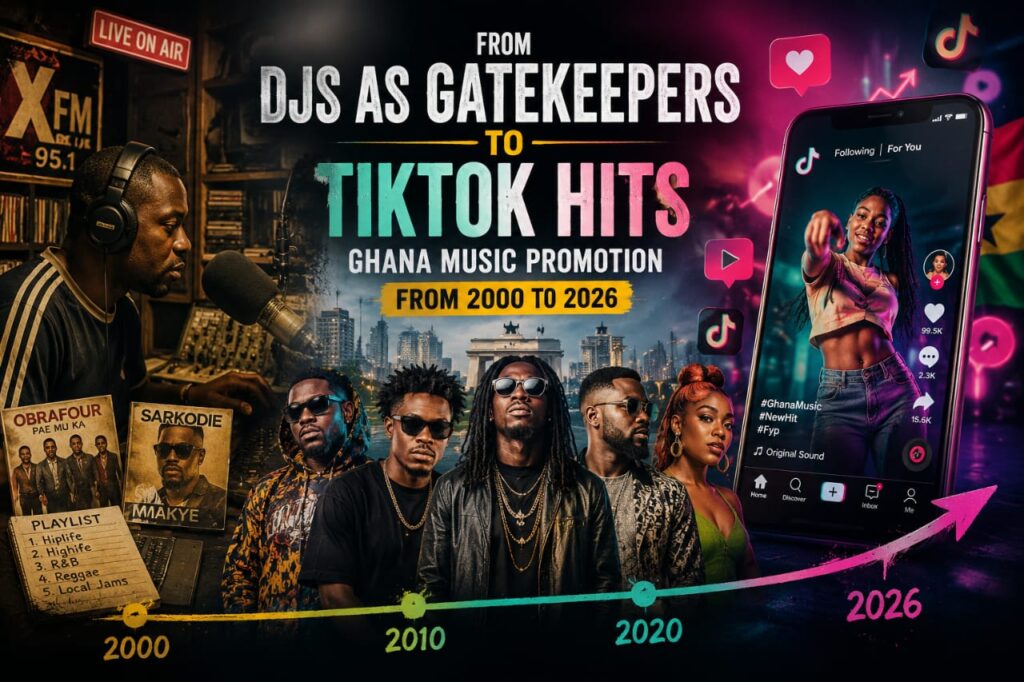
If you grew up on Ghanaian music in the early 2000s, one truth was clear. DJs controlled everything. If a DJ did not like your song, your talent did not matter. Radio rotation decided careers. TV exposure confirmed success. The Ghana Music Industry Ecosystem was small, physical, and tightly controlled. Today, in 2026, that power has shifted. Promotion no longer sits in one studio or one playlist. It moves through phones, communities, culture, and platforms. The story of Ghanaian music promotion is not about loss. It is about expansion.
When Promotion Was Physical and Personal
In the early 2000s, music promotion in Ghana was grounded in physical presence. Artists had to show up. CDs were pressed in bulk and delivered by hand to radio stations. DJs held power because they controlled rotation. If a DJ liked your song, your week changed. If not, your song disappeared quietly. This was the era that built artists like Obrafour, VIP, Reggie Rockstone, Tic Tac, and Lord Kenya into household names.
Promotion extended beyond radio. Posters were pasted on poles, walls, and kiosks across Accra and Kumasi. Album launches mattered. Street credibility mattered. People knew lyrics because songs stayed on rotation for months. The system moved slowly, but it rewarded patience and consistency. Once a song broke, it became part of everyday life.
Radio and TV as Cultural Gatekeepers
Radio and television did not support music promotion. They defined it. Shows curated taste and shaped public opinion. When your song crossed from radio to TV, it gained legitimacy. Music video quality mattered because TV exposure meant national visibility. Gold Blast on TV3 was not entertainment alone. It was a launchpad.
Newspapers also played a role. An artist featured in print carried status. Promotion followed a clear path and that path was narrow. The Ghana Music Industry Ecosystem at the time favored artists with funding, connections, and patience. Talent mattered, but access mattered more.
The Quiet Digital Disruption
The first digital shift did not arrive with noise. It crept in through MP3 sharing, memory cards, and Bluetooth transfers. Songs moved without CDs. Blogs emerged and listeners could download tracks without radio approval. Artists started to feel freedom, even if it was limited.
This period created a bridge generation. Artists still needed radio, but they no longer depended on it completely. Control weakened. Music started traveling faster than traditional structures could manage.
Shatta Wale and the Power Shift
Shatta Wale did not invent social media, but he understood it early. Instead of waiting for radio rotation, he built his base directly on Facebook. He spoke to fans daily. He performed on Facebook Live. He argued, explained, and entertained in real time. His music moved with his personality.
This approach changed promotion thinking. Attention became more valuable than approval. Community became more powerful than airplay. Shatta Wale proved that an artist could stay visible without traditional backing. This moment marked a clear turning point in the Ghana Music Industry Ecosystem.
Expansion, Not Replacement
As the system matured, it did not abandon old channels. It added new ones. Artists like Sarkodie balanced radio dominance with online reach. Stonebwoy combined traditional media respect with digital presence. The ecosystem widened.
By the time artists like KiDi, King Promise, Fameye, and Lasmid emerged, singles had overtaken albums. Speed mattered. Visibility mattered. Promotion became continuous, not seasonal. Radio still gave credibility, but first contact often happened online.
The New Ecosystem in Ghana Music Industry
Streaming and the Rise of Cultural Interpreters
Streaming changed listening habits, but commentary changed discovery. Streamers like Made in Ghana, Okelvis, and KevTheWave became cultural interpreters. They did not only play songs. They reacted, discussed, and explained why a track mattered. This added meaning to music.
In the modern Ghana Music Industry Ecosystem, songs travel with context. Listeners connect faster when someone they trust frames the sound. Music now spreads through personality as much as melody. My advise to old and new artists, grow with the trend, as streaming is becoming very popular in Ghana
YouTube Reactors
This is arguably one of the most controversial stakeholder in the ecosystem, but they have been very important, especially for upcoming artists. Youtube Platforms like Kwadwo Sheldon Studies (KSS). Headless Reactions. Some of the lyrics and punchlines gets over our heads but the music breakdowns helps us to enjoy the musics and appreciate the artists’ lyrical prowess.
TikTok and Participatory Promotion
TikTok introduced participatory promotion. Songs no longer waited for DJs or bloggers. Listeners became promoters. Dance challenges pushed tracks into everyday spaces. Songs by Moliy, Lasmid, KiDi, King Promise, and Fameye grew because people moved to them, laughed with them, and shared them repeatedly.
Many of these songs were already strong. Social media did not create quality. It multiplied reach. Promotion became collective effort rather than a top-down push.
Dance groups in Ghana have been instrumental in promoting Ghanaian music. From the days of Paa Tee to Azonto dance moves. Now we have DWP Academy, DG, Incredible Zigi, Alo Dancers, and the list goes on. In my opinion Dance category should be added to the Ghana Music Awards, but that another conversation for another day.
Culture, Sports, and Borderless Reach
Promotion now crosses industries. Stonebwoy’s connection with Mohammed Kudus shows how cultural identity expands reach. As Kudus played football in the Netherlands and London with clubs like Ajax, West Ham, and Tottenham Hotspur, Ghanaian music followed him into new spaces.
This type of exposure works because it feels natural. It is not forced advertising. It is cultural alignment. Music travels with pride and visibility. The Ghana Music Industry Ecosystem now thrives on these intersections.
The Wrong Conversation We Keep Having
Market size has become a distraction. Complaints about labels miss the point. Labels no longer control entry. Artists now control distribution. Fans control amplification. Platforms support reach.
Promotion today requires system awareness. Artists who study channels win. Artists who complain stall. The ecosystem rewards clarity, consistency, and cultural understanding.
I personally don’t want to talk about this, so one or two sentences is the only attention i gaving to this subject matter. Let’s move on. lol
What the Ecosystem Looks Like Beyond 2026
In 2026, Ghanaian artists must operate as media houses. Fans act as distributors. Traditional media supports credibility. Digital platforms drive speed. Strategy decides impact.
Good music still matters. Culture still decides acceptance. Community still decides longevity. The tools changed. The work stayed the same.
Written by Kelvin Kwesi Danquah
Digital Communication Specialist
Follow me on LinkedIn